I Use AI to Help Me Use AI
This is an operator’s account, not advice.
Core Thesis
I don’t use AI as a single tool.
I use it as a system.
One model helps me think.
Other models help me execute.
All of them help me stay oriented while I remain responsible for the outcome.
The value isn’t in any specific AI.
It’s in how I move between tools without losing intent.
The Operator Control Loop
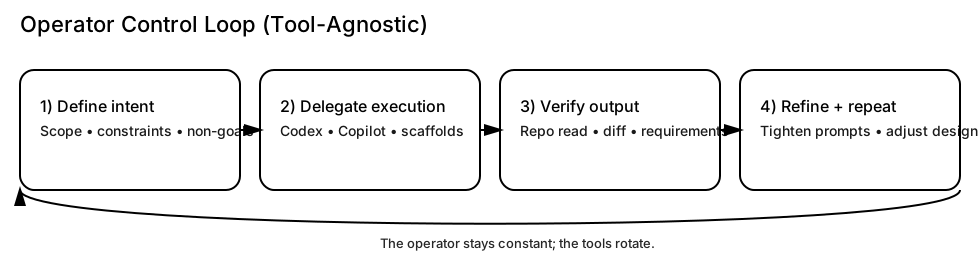
Why One AI Tool Is Not Enough
Different AI tools are optimized for different tasks:
- Reasoning and planning
- Code generation
- Scaffolding and layout
- Review and verification
Using one model for everything creates drift.
Context is lost. Assumptions accumulate. Errors hide.
Switching tools deliberately forces clarity.
Each transition is a checkpoint.
ChatGPT as the Planning Layer
I use ChatGPT primarily before anything is built.
- Narrowing scope
- Mapping workflows
- Stress-testing assumptions
- Thinking through layout and information flow
- Identifying likely failure points
This is not automation.
It’s pre-commitment.
Once intent is explicit, execution becomes safer—regardless of which AI tool does the work.
Prompting as Specification
I often use ChatGPT to generate prompts for other AI systems.
Those prompts function more like specifications than requests:
- Clear boundaries
- Explicit non-goals
- Defined inputs and outputs
Most downstream failures trace back to vague prompts upstream.
Treating prompting as a design task reduces rework later.
Using Specialized AI Tools for Execution
Once direction is set, I switch tools based on the task:
- Codex or Copilot for code generation
- Scaffolding tools for structure, not business logic
- ChatGPT again for reading and analysis
The tools change.
The intent doesn’t.
AI for Verification and Review
I regularly use AI to review AI-generated output:
- Reading repositories end-to-end
- Comparing results against original requirements
- Identifying missing logic or overreach
- Suggesting targeted improvements
This is where AI adds the most leverage—not as an author, but as a reviewer that doesn’t fatigue.
Closing
The point isn’t to find the right AI tool.
It’s to avoid anchoring your thinking to any single one.
Using multiple AI systems—intentionally—helps me stay on track, accountable, and in control of the work, even as the tools themselves continue to change.